

What Is Situational Awareness Training?
Situational awareness training teaches people how to notice what's happening around them, understand what it means, and anticipate what might happen next, so they can make safer, more confident decisions in the moment.

In this blog, we'll discuss what situational awareness is, explain how it can help you make safer decisions, and introduce you to Second Sight's training, which teaches situational awareness as a repeatable, teachable skill.
What is Situational Awareness?
Situational awareness as a concept is generally described in three parts: perceiving the relevant details in an environment, comprehending what those details mean together, and projecting how a situation is likely to unfold. This three-level model was formally defined by psychologist Mica Endsley, whose 1995 paper remains the foundational, most widely cited framework for studying situational awareness across fields including aviation, the military, medicine, and information technology.
Situational awareness operates on multiple levels: perceiving what's happening around you, understanding what those observations mean, and using that information to anticipate what might happen next. However, situational awareness alone doesn't guarantee a good outcome. Having strong situational awareness means having better information to work with, but it doesn't make the decision or take the action for you.
Situational Awareness and Personal Safety
Criminological research offers a related lens for understanding personal risk. Research tells us that offenders choose their time, place, and target based on a calculation of opportunity versus risk. They're looking for high reward and low risk. The Crime Triangle (also called the Problem Analysis Triangle), formally introduced by sociologists Lawrence Cohen and Marcus Felson in a 1979 paper holds that, for a crime to occur, three elements need to come together: a motivated offender, a suitable target or victim, and a place and time when no one capable of stopping the crime (i.e., a capable guardian) is present.
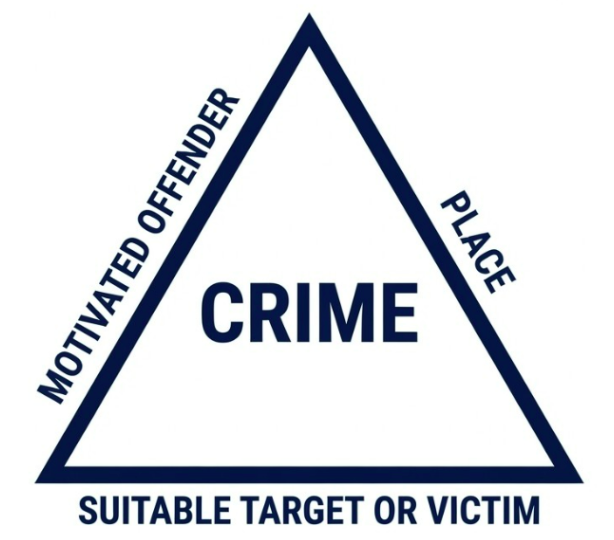
This means you can lower your own risk of being targeted just by staying aware of your surroundings, making yourself a less appealing, more difficult target. Altering any one side of the triangle, such as increasing visible surveillance, breaking predictable routines, or removing the opportunity for a crime to occur altogether, can reduce the likelihood of becoming a target.
National crime data helps explain why the Crime Triangle model works the way it does, and why staying aware of your surroundings matters so much. In 2024, stranger violence, meaning violent crime committed by someone the victim didn't know, accounted for 3,091,500 victimizations, a rate of 10.8 per 1,000 persons age 12 or older, the largest category of violent crime that year. Research also tells us that crime is not evenly distributed across the population. It tends to be driven by a relatively small number of motivated offenders. A landmark study published in 1972 found that just 6% of the group, later identified as "chronic" offenders, were responsible for 52% of all recorded offenses.
This matters because motivated offenders are not choosing targets at random. They are looking for an opportunity, someone who appears distracted, vulnerable, or easy to approach without being noticed or stopped. That is the exact combination the Crime Triangle describes, and it is why staying situationally aware, and reducing the opportunities you present to motivated offenders, makes such a difference. You may not be able to control whether a motivated offender is nearby, but you can control how easy or difficult a target you appear to be. For more information on the Crime Triangle framework, see our post on the 4 benefits of situational awareness.
Additionally, the National Institute for Occupational Safety and Health identifies situational awareness training as a key strategy for preventing workplace violence. And the National Highway Traffic Safety Administration has found that distracted driving contributes to the majority of vehicle collisions, underscoring the everyday value of staying attentive to a changing environment.
Research also supports the value of situational crime prevention measures in specific high-stakes contexts. A 2024 study by researchers Greene-Colozzi and Freilich found that measures that increased offender effort (e.g., door locks, enclosed fences, restricted entry) and reduced potential reward (e.g., lockdowns, formal and informal alert systems) helped reduce casualties during active shooter incidents. This protective effect held even against highly motivated offenders who had engaged in pre-incident behaviors, such as scouting the target location and expressing verbal or written intent. Overall, situational crime prevention tactics increased offender effort and made potential targets less accessible, ultimately limiting the harm an offender is able to inflict.
Filtering out the Benign
At Second Sight, we approach situational awareness by assessing patterns of consistent behavior. These patterns, specific to a time and place, allow the observer to establish the pattern, and, with this pattern, behaviors that differ from it become easier to recognize. Not all of the behaviors that differ from this pattern of consistent behavior are threats, but they can allow the observer to dismiss non-threats and take preventative action based on behaviors they cannot explain or they perceive as threatening.
We do this by training our observers in systematic observation techniques. We train in a replicable process that involves assessing any environment along 7 types of behavior. We have an advanced approach designed for law enforcement and security practitioners, and an approach that is designed for anyone to apply in personal and workplace settings through our Situational Awareness for Safety course.
Situational Awareness for Safety
Our Situational Awareness for Safety course is grounded in techniques developed through research with law enforcement officers across the United States, validated by social scientists and experienced practitioners under the Just Doesn't Look Right (JDLR) Project, which was supported by the Rapid Reaction Technology Office of the U.S. Office of the Secretary of Defense.
The course teaches participants to:
Assess patterns of consistent behavior in any environment
Identify behaviors that deviate from those patterns and may signal a potential threat
Identify possible courses of action based on their assessments

Who This Training Is For
Our situational awareness training teaches people how to systematically observe any environment, identify behavioral indicators, and spot things when things just don’t look right. This course is designed for public-facing professionals responsible for safety, awareness, and decision-making, including healthcare workers, educational professionals, field workers, customer-facing staff in retail and hospitality, warehouse and logistics staff, and office personnel. Past trainees include healthcare professionals, teachers, higher education faculty and staff, customer service personnel, retail and hospitality staff, and social and community service workers. The skills apply equally to workplace settings and personal safety.
Second Sight recently updated Situational Awareness for Safety based on feedback from past participants, refining the course to improve the overall learning experience. We also have a more advanced threat awareness training designed for law enforcement and security professionals to help them thoroughly evaluate visual threats and behaviors when conducting their own observations or when investigating reported concerns.
What the Evaluation Data Shows
Second Sight has trained thousands of individuals in situational awareness since 2021. After 467 participants completed our online Situational Awareness for Safety course:
96.8% reported feeling better prepared to observe any environment
96.8% reported feeling better prepared to look for threats
95.1% said they felt prepared to take action and keep themselves safe
These results hold up across different regions and audiences for in-person courses as well. In an April 2023 series of instructor-led training for 183 employees of Benton County, Oregon, more than 90% of trainees reported feeling better prepared to observe their environment, look for threats, and take necessary action to keep themselves safe. The participants also reported high levels of course satisfaction, with the majority agreeing that the course provided enough opportunity to practice the skills (93.9%), relevant examples (94.5%), and clear communication from instructors (97.8%). In a June 2024 training series across four counties in Western Massachusetts, all 53 surveyed trainees agreed the course left them better prepared to observe their environment, look for threats, and take action to stay safe.

Course Format and Logistics
Situational Awareness for Safety is available in two formats:
Self-paced online, approximately 1 hour, available on demand 24/7, with progress saved so it can be completed over time
Instructor-led, approximately 2 hours, capped at 50 participants per session for a high-quality experience, with a take-home guidebook covering key concepts
The course combines lecture material, interactive videos, and practical exercises, and all participants completing the course receive a certificate of completion. Completion also provides CPE credit toward maintaining APP, CPP, PCI, and PSP credentials (Second Sight is an ASIS International Preferred CPE Provider).
Pricing starts at $50 per participant for an individual license, with volume discounts, subscriptions, and instructor-led pricing available for organizations. The course can also be bundled with Best Practices in Fieldwork Safety and De-Escalation: Theory to Practice for organizations seeking more comprehensive safety training.
Learn more about Situational Awareness for Safety, including pricing, course logistics, and answers to frequently asked questions.
-
Bureau of Justice Statistics. (2025). Criminal victimization, 2024 (NCJ 310547). U.S. Department of Justice, Office of Justice Programs. https://bjs.ojp.gov/library/publications/criminal-victimization-2024
Cohen, L. E., & Felson, M. (1979). Social change and crime rate trends: A routine activity approach. American Sociological Review, 44, 588-608. https://faculty.washington.edu/matsueda/courses/587/readings/Cohen%20and%20Felson%201979%20Routine%20Activities.pdf
Center for Problem-Oriented Policing. (n.d.). The Problem Analysis Triangle. Arizona State University. https://popcenter.asu.edu/content/problem-analysis-triangle-0
Endsley, M. R. (1995). Toward a theory of situation awareness in dynamic systems. Human Factors: The Journal of the Human Factors and Ergonomics Society, 37(1), 32-64. https://www.digishape.nl/wp-content/uploads/2024/11/endsley_mr_toward_a_theory_of_situation_awareness_.pdf
Greene-Colozzi, E. A., & Freilich, J. D. (2024). Situational crime prevention as a harm mitigation policy for active shooter incidents. Criminology & Public Policy, 1-33. https://onlinelibrary.wiley.com/doi/epdf/10.1111/1745-9133.12686
Mohn, E. (2021). Research starter: Situational awareness. EBSCO. https://www.ebsco.com/research-starters/social-sciences-and-humanities/situational-awareness#research-starter-title
National Highway Traffic Safety Administration (NHTSA). (2020). Distracted Driving. In Countermeasures That Work, 10th Ed. https://www.nhtsa.gov/book/countermeasures-that-work/distracted-driving
National Institute for Occupational Safety and Health (NIOSH). (2021). Workplace Violence. https://www.osha.gov/workplace-violence/prevention-programs
Wolfgang, M. E., Figlio, R. M., & Sellin, T. (1972). Delinquency in a birth cohort. University of Chicago Press. https://press.uchicago.edu/ucp/books/book/chicago/D/bo83532686.html