

Interview Training in Child Protective Service Investigations: A Case Study

In child protective services (CPS), the quality of an interview can directly influence outcomes for vulnerable children and families. CPS caseworkers are responsible for gathering reliable information while navigating legal, ethical, and safety considerations. Effective interviewing in this context involves adapting communication strategies to the situation—balancing rapport-building, evidence collection, and structured questioning depending on the interviewee and investigative goals.
To strengthen interviewing practices, a two-day training program was delivered to 57 child services professionals in the state of Nevada. Participants included child protective services (CPS) caseworkers who conduct child abuse and neglect investigations from Washoe County and the Nevada Department of Child and Family Services.
In this post, we examine participant feedback of individuals who completed the program, drawing on post-training survey data. The training cohort consisted of CPS professionals actively engaged in child welfare investigations, including both supervisors and caseworkers from Washoe County Child Protective Services and the State of Nevada Department of Child and Family Services. These individuals are tasked with making critical determinations about child safety and accusations of abuse and neglect, often under time pressure and with incomplete information.
The group reflected a range of ages and years of experience, allowing for both foundational skill-building and refinement of existing investigative approaches. Ages ranged from 18-54, with the majority of participants (69%) being between 25 and 44 years of age. Years of experience among participants ranged from 6 months to 24 years, with a median of 5.25 years of experience.
Rapport-Based Evidence Presentation
The instructor-led Interview Planning and Credibility Assessment in Child and Adult Protective Services program teaches participants how to present evidence in a structured and strategic manner that enhances rapport, supports credibility assessment, and improves information gathering during investigative interviews.
One of the most well-known evidence-presentation techniques is the Strategic Use of Evidence (SUE) approach, which is designed to elicit an open-ended narrative from the subject, followed by the strategic disclosure of evidence to test and challenge their account. SUE has been found to be effective in detecting deception and eliciting confessions.
Rather than treating SUE as a standalone method, the program positions it as one component within a broader framework known as the Rapport-Based Evidence Presentation (REP) model, which is the foundation for our investigative interviewing program. The model was developed through an extensive literature review, consultation with subject matter experts, and systematic analysis of interview data as part of a recent Department of Defense contract in collaboration with Dr. Christopher Kelly at Saint Joseph’s University.

While the REP model incorporates the strategic use of evidence, it places a greater emphasis on maintaining rapport through non-confrontational interviewing techniques. The simultaneous focus of building rapport alongside the gradual and structured presentation of evidence, is designed to reduce resistance and increase information yield. Within this broader framework, elements of the SUE approach are applied specifically during the credibility assessment phase, particularly in relation to the timing and sequencing of evidence disclosure and the identification of statement-evidence inconsistencies.
For more information about investigative interviewing techniques more generally, check out our companion post: “12 Key Interview Techniques for Investigators.”
Program Overview
“One of the best trainings I’ve done. Super engaging, different presenter styles helped reach the whole group. I appreciate that the trainers pushed back on us to push us into learning even more about how to use this in our work.”
This instructor-led program is grounded in science-based interviewing principles and is designed for investigative interviews with adult subjects (e.g., alleged perpetrators) in CPS and adult protective services (APS) cases. It is not a forensic interviewing program and does not focus on interviewing children. Instead, it is intended to support early-career caseworkers, strengthening core investigative interviewing competencies.
The program is structured to improve interview planning and execution, enhance rapport-building and information elicitation, and strengthen case documentation and defensibility. The program consists of two sequential courses that emphasize improving the quality, structure, and reliability of information gathered during adult subject interviews.

Course 1, Interview Planning Fundamentals, focuses on building a strong foundation for effective interviews. Participants learned rapport-building techniques to facilitate cooperation, methods for eliciting a free narrative, strategic questioning approaches, and how to use information funnels to improve their collection of relevant information.
Course 2, Evidence Planning and Credibility Assessment, focuses on a structured framework for evaluating information and evidence in an investigation. Participant learned how to evaluate and organize evidence using the evidence-framing matrix, assess credibility through analysis of statement-evidence inconsistencies, develop an evidence disclosure strategy, and challenge inconsistencies.
In both courses, participants receive practical handouts, including interview and evidence-planning tools designed for immediate field application.
“This training made me feel like I was present and learning throughout each exercise. Very active and entertaining instructors. I enjoyed the training overall!”
The training emphasized practical application through contextually relevant, structured case studies, in the case of these deliveries, our initial case studies involved educational neglect and lack of parental supervision. Participants also had the opportunity to bring in a real case from their current caseload and apply program techniques immediately. This allowed participants to apply their new interview and evidence-planning tools in a context directly relevant to their responsibilities, reinforcing skill transfer beyond the classroom.
For a broader overview of how investigative interviewing frameworks are adapted for child protective services, particularly the differences in purpose, subject type, and interviewing approach, see our companion post: “Interviewing in Child and Adult Protective Services.”

Participant Feedback
Post-training survey data from participants indicated strong positive reactions to the program and high levels of self-reported learning.
“Multiple people expressed that this was the best training they ever received. The presentation was very engaging and interesting throughout. The information is directly relevant to what we do on multiple levels. It was great that presenters were open and receptive to feedback as we went along. Very well done!”
Using the Kirkpatrick Model—a widely used framework for training evaluation—these findings primarily reflect Level 1 (participant reaction) and some elements of Level 2 (perceived learning). In other words, the post-training survey data captures participants’ experiences with the program, perceived preparedness, and intended application of skills, rather than independently measured changes in field performance.
In this section, we summarize key participant feedback and survey findings related to learning experiences, perceived preparedness, and intended application of program techniques in the field.
Interview Planning
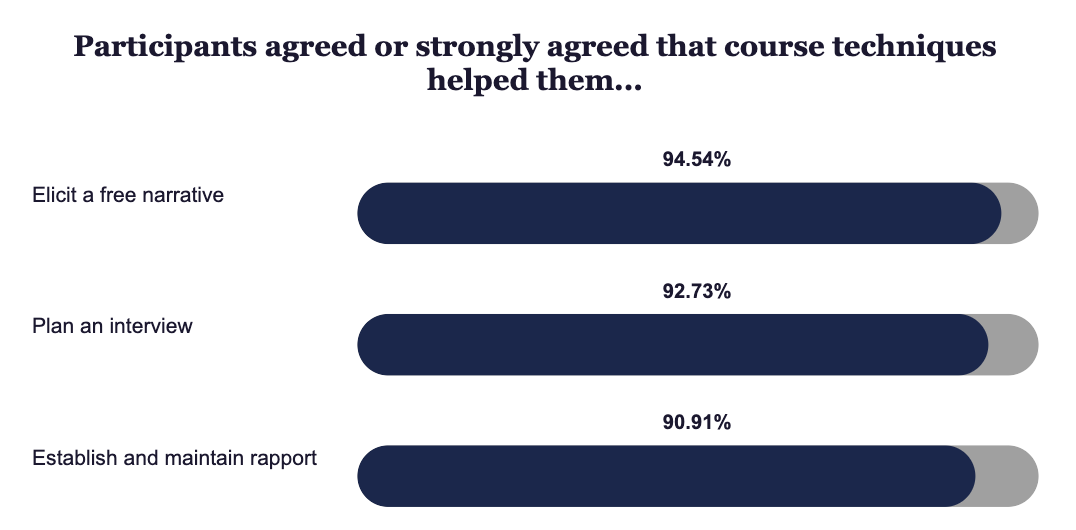
Interview planning is a key component of our program. More than 90% of participants agreed or strongly agreed that they felt better prepared to elicit a free narrative, plan for an interview, and establish and maintain rapport.
Evidence Planning and Credibility Assessment
“Great training. This should be provided to call staff who are incoming/learning interview skills.”
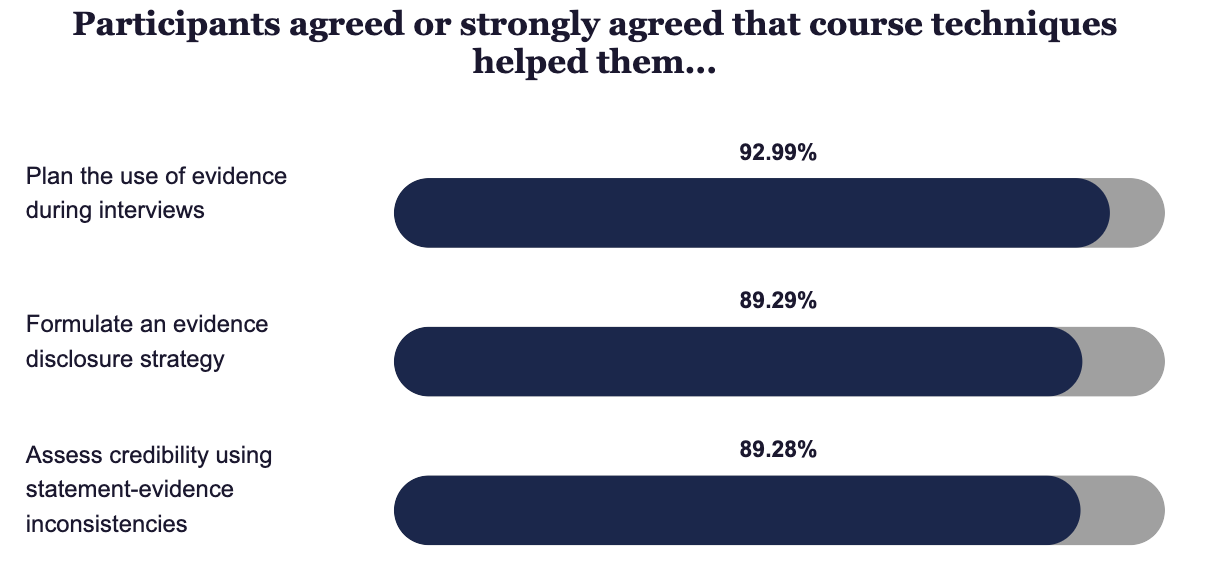
Evidence planning and credibility assessment are also key components of the program. Post-program surveys found that approximately 90% of participants felt better prepared to plan the use of evidence during interviews, formulate an evidence disclosure strategy, and assess credibility using statement-evidence inconsistencies.
Learning and Conceptual Frameworks
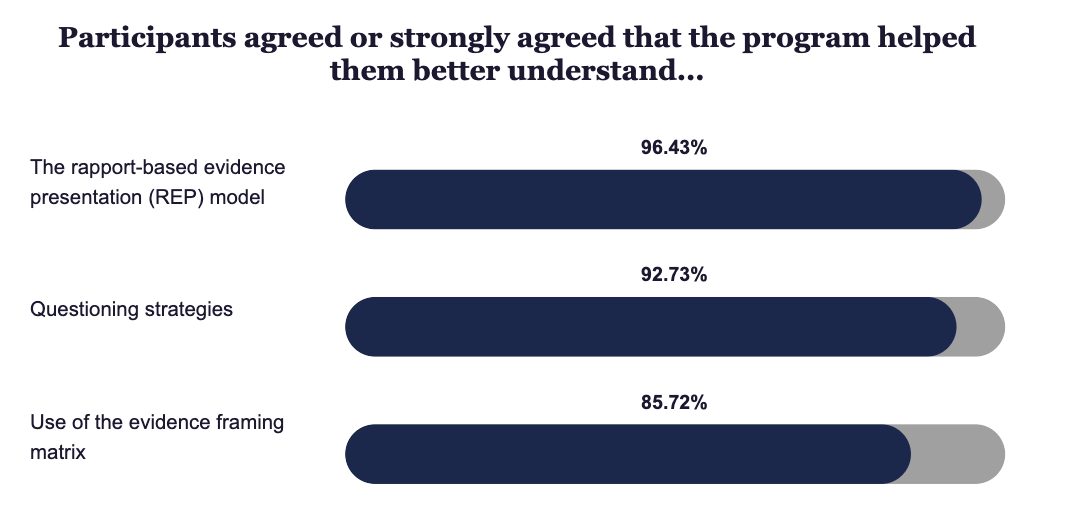
Participants also reported improved understanding of the Rapport-based Evidence Presentation (REP) model, strategic questioning strategies, and use of the evidence framing matrix.
Job Relevance and Perceived Field Utility
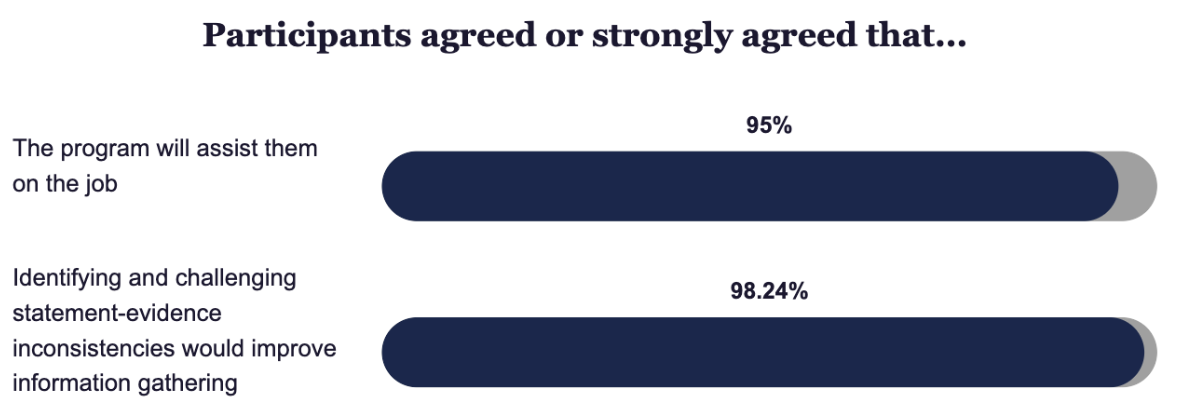
The majority of participants found the skills relevant to their work, with 95% agreeing or strongly agreeing that the program techniques would help them on the job. Further, nearly all participants agreed that their new skills would improve their ability to gather information.
Interview and Evidence Planning Tools
“I really enjoyed the interview planning tool. I feel that I can be better organized and I can focus on what I want to focus on and plan my day when I have to see clients...”
Participants also found the interview and evidence planning tools helpful, with more than 80% of participants indicating that they plan to use these tools in the future.
Additionally, supervisory staff and management report that they are planning to integrate these interview and evidence planning tools into ongoing supervisory meetings with caseworkers going forward. This shift suggests the training is influencing not only individual performance, but also team-level processes and organizational practice.
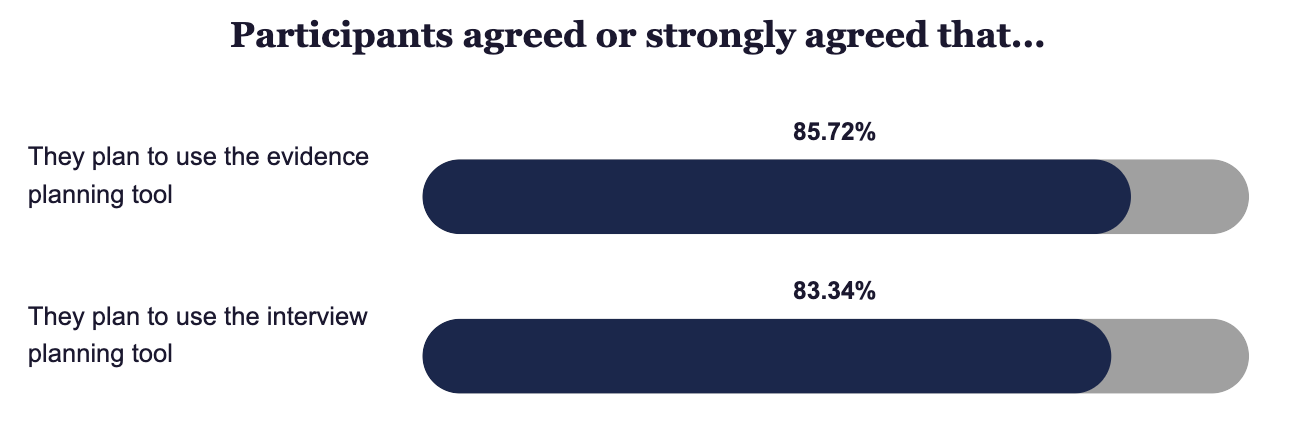
Overall, these findings suggest not only knowledge acquisition but also a high likelihood of behavioral change in the field.
Conclusion
Participant feedback indicated perceived improvements in investigative preparedness, interview strategy, and evidence handling following the Washoe County CPS training program. Techniques such as structured interview planning and the identification of statement-evidence inconsistencies were consistently rated as useful.
Participants reported increased confidence in their ability to plan for their interviews, evaluate credibility, and apply evidence strategically. Just as important, the majority indicated clear intent to implement the tools and frameworks introduced during the training.
These results indicate that structured, evidence-based interview training can produce meaningful improvements in CPS investigative work. Beyond CPS investigations, interview and evidence planning courses are also frequently used by other audiences, such as law enforcement professionals.
Get in touch with us or visit the program page to learn more or get this training for your team.
-
Granhag, P. A., Strömwall, L. A., Willén, R. M., & Hartwig, M. (2012). Eliciting cues to deception by tactical disclosure of evidence: The first test of the Evidence Framing Matrix. Legal and Criminological Psychology, 18(2), 341-355. https://doi.org/10.1111/j.2044-8333.2012.02047.x
Hartwig, M., Granhag, P. A., & Luke, T. (2014). Strategic use of evidence during investigative interviews: The state of the science. Credibility Assessment, 1-36. https://doi.org/10.1016/B978-0-12-394433-7.00001-4
Kelly, C. E., Parker, M., Meehan, N., & McClary, M. (2025). Evidence presentation in suspect interviews: A review of the literature. The Police Journal, 98(1). 112-238. https://journals.sagepub.com/doi/abs/10.1177/0032258X241243286
Kirkpatrick, D. L. (1994). Evaluating Training Programs. The Four Levels. Berrett-Koehler Organizational Performance Series. Berrett-Koehler Publishers, Inc., 155 Montgomery Street, San Francisco, CA 94104-4109. https://eric.ed.gov/?id=ED382790
Luke, T. J., Hartwig, M., Joseph, E., Brimbal, L., Chan, G., Dawson, E., ... & Granhag, P. A. (2016). Training in the Strategic Use of Evidence technique: Improving deception detection accuracy of American law enforcement officers. Journal of Police and Criminal Psychology, 31(4), 270-278. https://psycnet.apa.org/doi/10.1007/s11896-015-9187-0
May, L., Granhag, P. A., & Tekin, S. (2017). Interviewing suspects in denial: On how different evidence disclosure modes affect the elicitation of new critical information. Frontiers in Psychology, 8, 1154. https://www.frontiersin.org/journals/psychology/articles/10.3389/fpsyg.2017.01154/full
Second Sight Training Systems. (2026). “Interviewing in Child and Adult Protective Services.” https://www.secondsight-ts.com/threat-assessment-blog/abuse-and-neglect-interviews
Second Sight Training Systems. (2025). “12 Key Interview Techniques for Investigators.” https://www.secondsight-ts.com/threat-assessment-blog/interview-techniques
Second Sight Training Systems. (2023). “Enhancing Communication: The Power of Active Listening Skills.” https://www.secondsight-ts.com/threat-assessment-blog/active-listening-skills