

Recognizing and Responding to Threats in the Real World
In the security and law enforcement industries, accurately identifying and responding to threats is critical to maintaining safe spaces. Whether it involves reacting to active threats in real time or strengthening long-term predictive capabilities, threat detection and awareness are vital strategies to prevent violent incidents and reduce risk.
Most security failures are not caused by a lack of procedures or equipment, but by missed or misinterpreted behavior. Professionals responsible for assessing potential threats often rely on intuition, experience, or fragmented indicators without a shared, defensible framework or language to explain what they are seeing or why a decision was made.

Prevention begins with disciplined observation and informed judgment. To help meet this need, Second Sight provides active threat assessment training that teaches professionals to recognize early indicators of threat. Early detection allows intervention before situations escalate. Grounded in a proactive training approach, Second Sight's active threat assessment methodology focuses on behavioral observation, baselining, and threat interpretation—rather than reactive incident response or tactical engagement.
In the Threat Awareness program, participants learn how to apply a disciplined observation process, recognize relevant behavioral deviations early, and communicate their assessments with clarity, confidence, and professional credibility. Since completing their training, 1 in 2 participants used these skills every day.
To date, Second Sight has delivered the 8-hour Threat Awareness program to thousands of security and law enforcement professionals worldwide. Because knowledge and skills gained through training can decay over time, a 1-hour refresher is offered 6-12 months after the initial session to reinforce key concepts.
As of 2026, 143 law enforcement and security personnel had completed this refresher training. In this post, we share feedback from those participants, providing insight into how they use program techniques on the job.
Personally, I am proud that our trainees use their skills daily to protect themselves and others. Just as importantly, 97.2% of our trainees reported that program techniques helped them in their security or law enforcement mission. This is a win.

Active Threat Assessment
Our main programs are called “Threat Awareness” for a reason. Our goal is to equip professionals to systematically observe behavior, identify meaningful deviations, and articulate defensible decisions before threats escalate. Overall, these skills help participants strengthen their decision-making, reporting, supervision, and accountability across safety and security operations.
Second Sight training equips professionals with a systematic approach to advanced situational awareness and threat interpretation. Our training translates validated behavioral research into practical, repeatable skills personnel can apply immediately to recognize, interpret, and act on early indicators of threat.
The methodology teaches professionals how to:
Establish behavioral baselines for people and environments
Identify meaningful deviations from those baselines
Assess the relevance of observed behaviors
Articulate observations and decisions clearly and defensibly for reporting, supervision, and review
Training is delivered through online and instructor-led formats designed to mirror real operational conditions, including surveillance, patrol, access control, and public-facing security roles. All programs are grounded in the Department of Defense–funded “Just Doesn’t Look Right” research and validated by social scientists and experienced practitioners.
Compared to traditional lecture-based sessions, the Threat Awareness program emphasizes practical skill-building through scenario-based learning and real-time feedback. This approach actively engages trainees in practicing observation, critical thinking, and communication skills, which is more effective than passive learning methods (e.g., memorizing information from lectures) leading to better retention and real-world application under pressure.
For a more detailed explanation of the instructional design principles underpinning our training methodology, check out our companion publication: “Instructional Design and Active Threat Assessment Training.”

Operational Relevance
“Working in surveillance, I am able to identify a person of interest faster than before I had taken this course.”
Law enforcement and security professionals completing this program also report that the Threat Awareness program's techniques support their work, reflecting the practical utility of the training in real-world environments.
97.2% of participants who completed the refresher training agreed that course materials would help them in their job, and 91.6% indicated that they had applied skills on the job within the 12 months following the training.
“I have used this course to identify armed suspects multiple times and use the threat indicators often.”
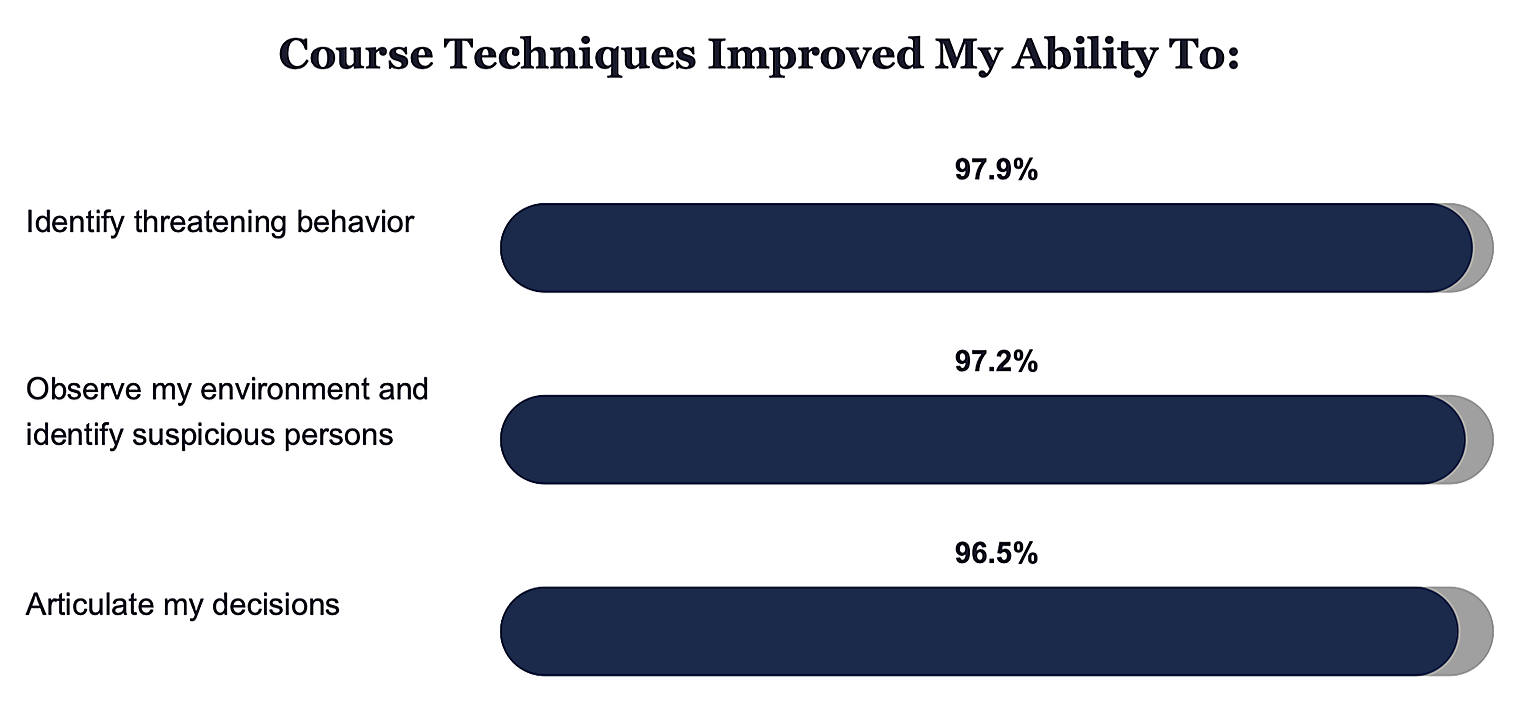
Most participants agreed that the skills learned during the program enhanced their ability to identify suspicious persons (97.2%), identify threatening behavior (97.9%), and better articulate and explain their decision-making (96.5%). This is strong feedback from a wide cadre of experienced practitioners with at least 6 months of field use.
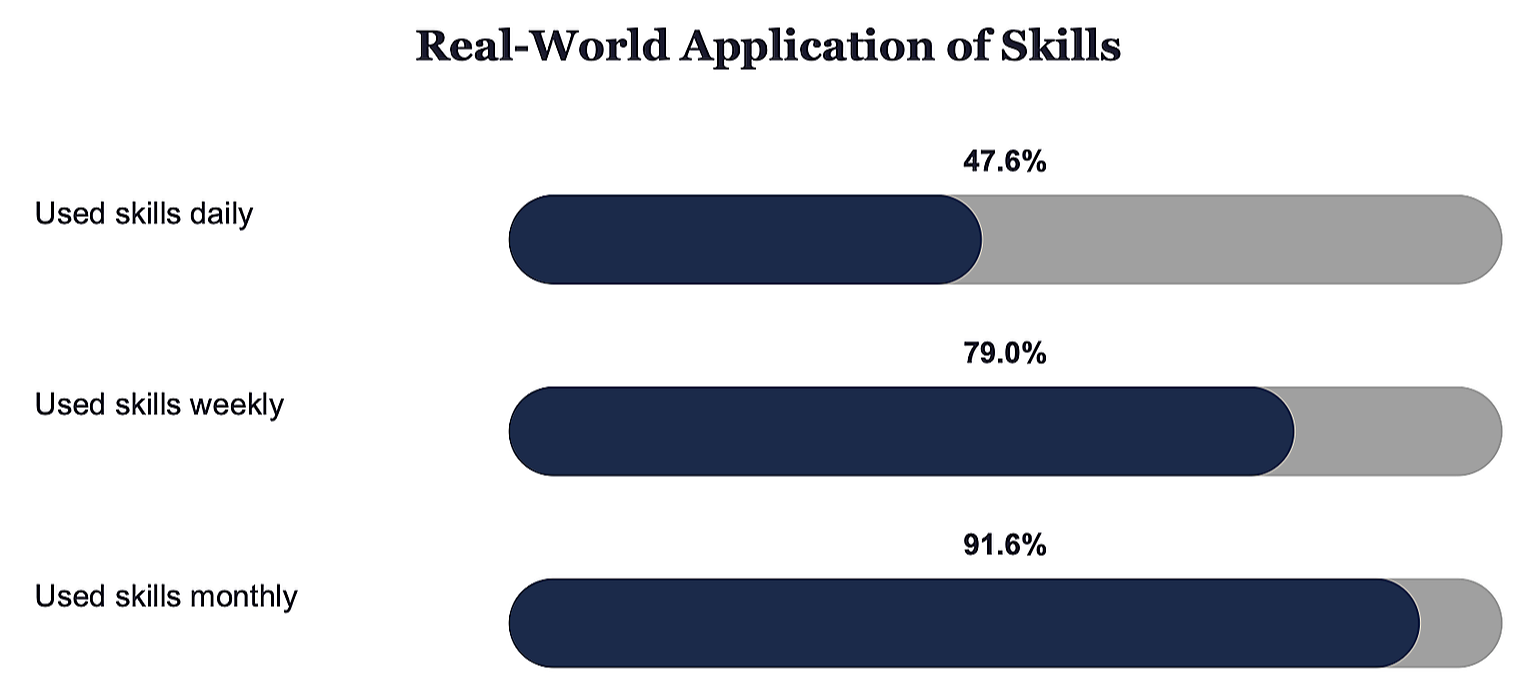
When asked how frequently participants used the skills taught during the Threat Awareness program, responses showed strong integration into daily and weekly workflows, with nearly one out of every two participants (47.6%) indicating they used the skills every day. In addition, 79% used the skills at least weekly, and 91.6% used the skills at least monthly.
This feedback confirms that the training helped participants feel better prepared on the job, and that skills were frequently integrated into their duties. Together, these findings demonstrate that Threat Awareness improves threat recognition, real-time decision-making, and day-to-day vigilance.
Learn More
The Threat Awareness program has helped deliver measurable improvements in observational abilities, decision-making, and communication, all of which are critical capabilities for law enforcement and security professions.
Overall, key benefits of this training include:
Earlier identification of potential threats
Improved articulation and report writing
Increased confidence in judgment and decision-making
Reduced escalation and unnecessary intervention
Greater consistency across teams and shifts
Training that integrates into existing security operations
Our training equips teams with a consistent framework for detecting, communicating, and articulating threats across the organization. This creates a shared foundation and common language for all team members across various functions, departments, and locations, enhancing situational awareness and decision-making at every level.
For more information about the training program and to learn how Second Sight Training can help your team, click the button below to learn more.