

Empowering Prevention: Lessons Learned from Brown University Shooting
On December 13, 2025, a gunman fired dozens of rounds into a classroom at Brown University in Providence, Rhode Island, during final exam week. The attack resulted in two student deaths and nine others wounded. Authorities issued emergency alerts and launched a manhunt for the suspect, who was later found dead. The incident prompted reviews of campus safety procedures and emergency response systems.

In the days leading up to the attack, some members of the campus community noticed behaviors that simply did not seem right. For example, a custodian repeatedly observed the suspect lingering on campus and in classrooms, while scanning the environment in a way consistent with pre-attack surveillance.
Understanding the Pathway to Mass Violence
Sadly, Brown University is not an isolated case. Research shows that mass attacks are frequently preceded by observable warning signs, such as testing security at potential targets, probing access points for vulnerabilities, and attempting to gain unauthorized entry. Perpetrators typically plan and prepare in advance, and it is not uncommon for attackers to spend days familiarizing themselves with the location and routines of their intended targets.
Several clear warning signs were present in the days leading up to the attack. Specifically, a suspicious individual was seen:
Repeatedly appearing in and around the same buildings,
Browsing and scanning classrooms,
Conducting pre-attack surveillance of the area surrounding the Barus and Holley building,
Exhibiting an unusual gait, a sign that can sometimes indicate someone is carrying a concealed weapon,
Present at a time when buildings should have been locked and secured (i.e., on Saturdays).
When talking to detectives, the custodian explained, “it was like I could see him and nobody else could — it is an eerie feeling. It was the way he was browsing in the classrooms. He was like rolling his eyes one way, rolling his eyes another way. And it wasn’t just that classroom, it was all the classrooms.”

Regarding the feeling he had when encountering the suspect on campus, he stated that, “Something kept telling me, ‘Don’t ignore it.’” He encouraged other people to “go with your gut feeling” if they see something concerning or suspicious.
Knowing When to Report
Many people hesitate to report concerning behavior even when something feels off. Often, they cannot fully explain what they are seeing, only that it feels strange or out of place. Others worry they may be overreacting and dismiss their instincts. Some feel unsure about who they are supposed to report to in the first place.
This uncertainty is common and understandable. Without a shared framework for recognizing threats, people may second-guess themselves and stay silent. With proper training and education, individuals can learn how to identify meaningful patterns, articulate what they are observing, and feel more confident about when and how to report concerning behavior.
Situational Awareness and Threat Assessment
Second Sight's Situational Awareness training teaches people how to systematically observe any environment, identify behavioral indicators, and spot things when things just don't look right. You can read more about what situational awareness training actually involves in our companion post. While this course is available for individuals across schools, workplaces, and community settings, we also have a more advanced Threat Awareness Training Program that helps security and law enforcement professionals thoroughly evaluate visual threats when they are reported, or when they are conducting their own observations.
Keep in mind that there is no single behavior that proves intent. Rather, patterns and clusters of behaviors matter. Our goal is to help people distinguish between actions that may simply be odd and those that could indicate a potential threat.
"Reporting concerns to proper authorities is not about making accusations, but is about sharing observations and information. Early reporting allows for prevention. It does not automatically lead to punishment, but can lead to support, intervention, or monitoring. For more information, check out our companion post, “Active Shooter Prevention: Understanding 'Left of Boom'.”

Trainee Testimonial:
We use these techniques every day, but many of us have never been able to articulate the ‘why’ in what we see. This program gives us a way to describe and explain what took us years to observe. - Security Manager
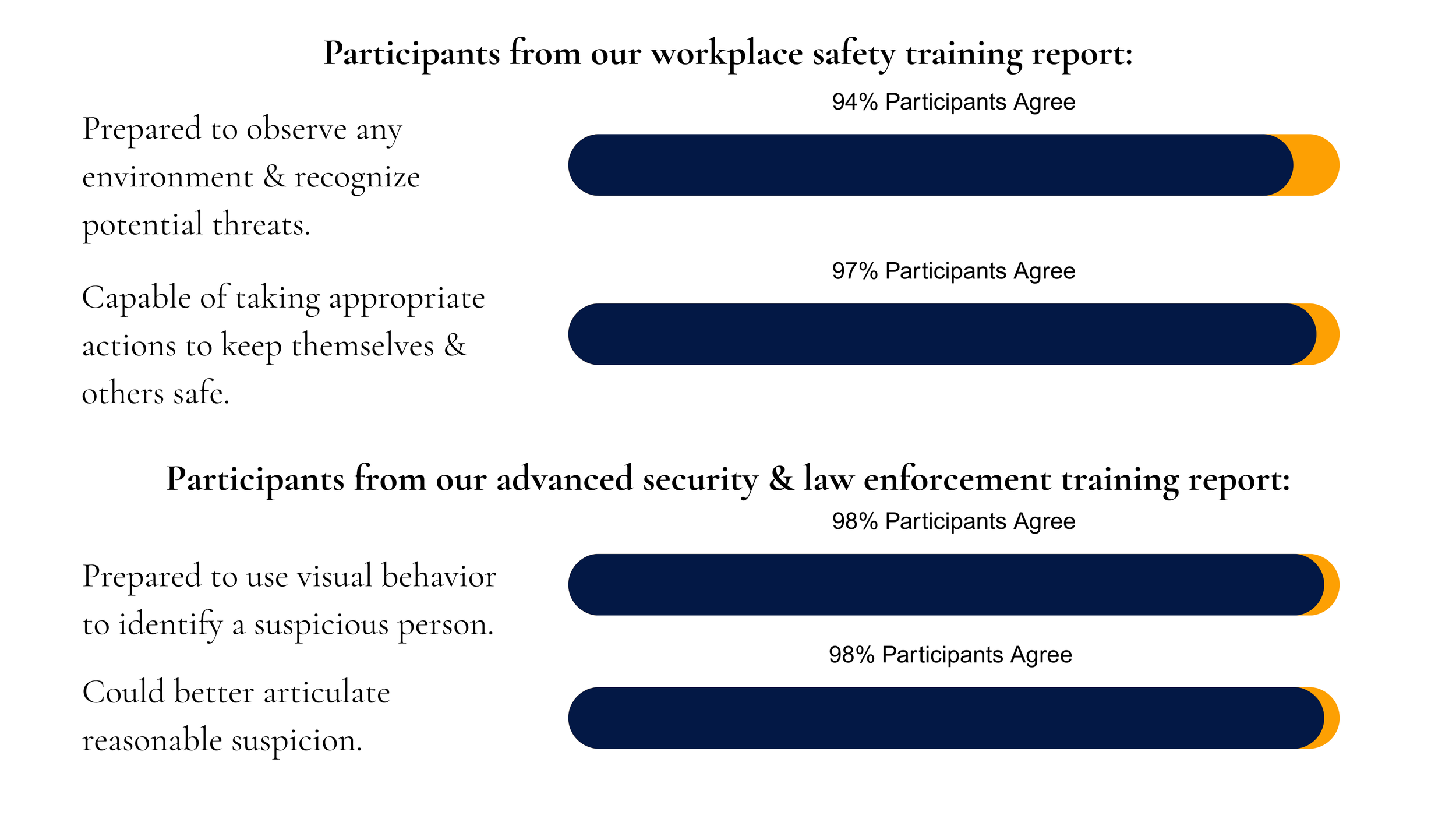
Participants in our programs consistently report that the training increases their confidence and clarity when identifying and communicating concerns. Past attendees have shared that the course helped them better understand what to look for and how to trust and articulate their observations.
Lessons Learned
The Brown University shooting was a tragic event that offers important lessons. In many cases, violence is not random. Tragedies are sometimes preventable when people understand what to look for and how to respond.
In this instance, early indicators were present, and the individuals who noticed concerning behavior and chose to speak up should be commended for trusting their instincts and taking action. At the same time, the situation highlights how unclear reporting pathways can limit the impact of those warnings.
Call to Action
Empowering people with education and training helps them make informed decisions about when and what to report, and how to communicate their observations clearly. Prevention is a shared responsibility that is strengthened through situational awareness, responsible reporting, and a collective commitment to noticing and acting before harm occurs.
Interested in getting situational awareness training for your campus? Visit our higher education page to learn how we can support your institution.
-
Cybersecurity and Infrastructure Security Agency (CISA). (2025). “Pathway to violence: Warning signs and what you can do.” Department of Homeland Security. https://www.cisa.gov/sites/default/files/2025-03/CISA_Pathway_to_Violence_Fact_Sheet_508_20250319.pdf
FBI. (2025). “Active shooter incidents in the United States in 2024.” Department of Justice. https://www.fbi.gov/file-repository/reports-and-publications/2024-active-shooter-report/view
Flower, J., Sherman, E., Guernelli, S. (Dec. 22, 2025). “‘Don’t ignore it’: Brown University custodian says he reported gunman multiple times before shooting.” WPRI News 12. https://www.wpri.com/news/local-news/providence/dont-ignore-it-brown-university-custodian-says-he-reported-gunman-multiple-times-before-shooting/
RAND Corporation. (2026). “What warning signs look like and where they have come from.” Mass Attacks Defense Toolkit. https://www.rand.org/pubs/tools/TLA1613-1/toolkit/prevent/initial-detection/warning-signs.html